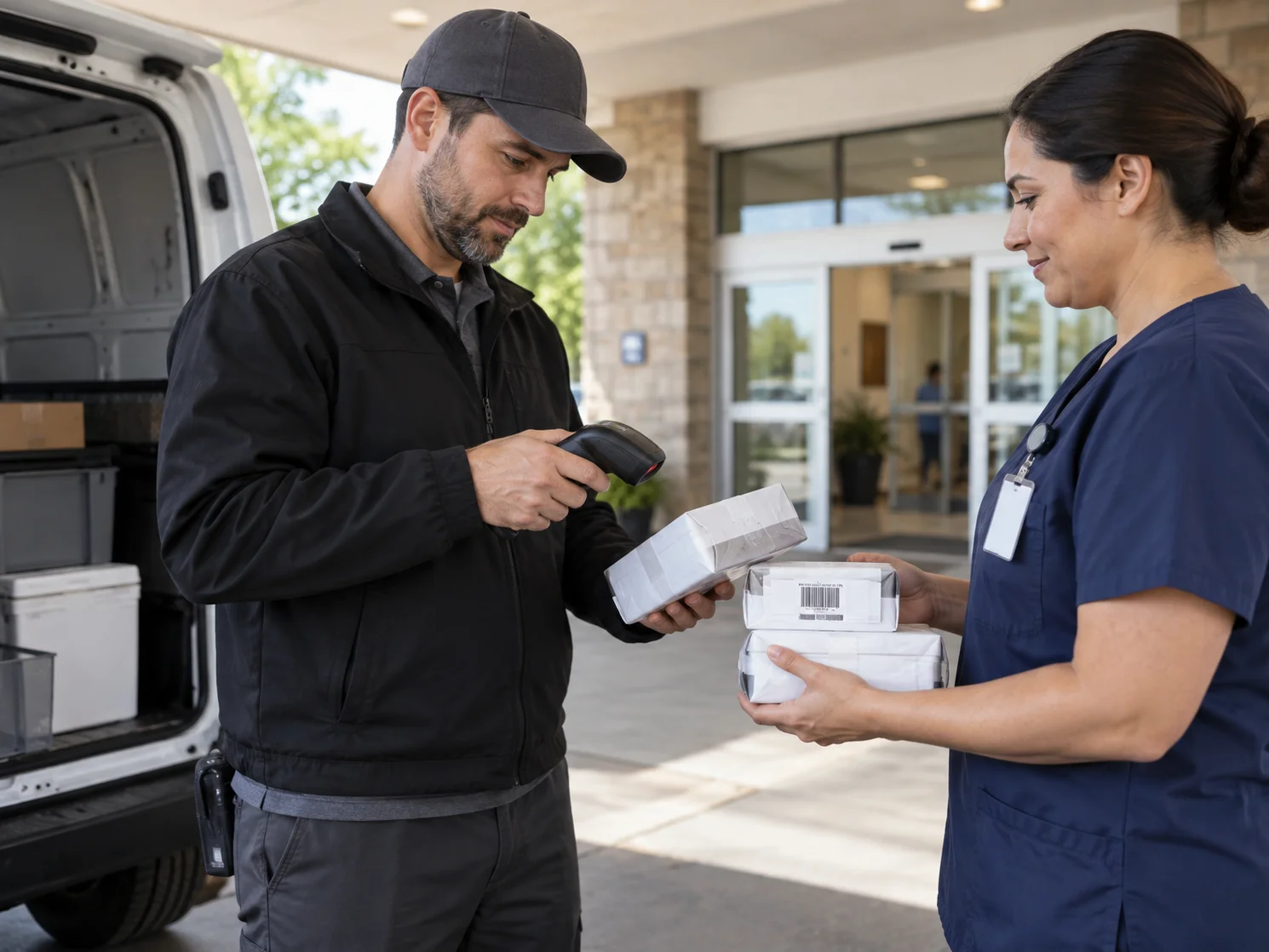
A completed delivery is not enough when a shipment contains several prescription packages, specimen containers, or other individually identified items. The question a pharmacy, clinic, lab, or hospital customer may ask is more specific: Was every item in the shipment collected or delivered to the right place?
Item-level barcode scanning gives courier operations a practical control point for answering that question. OnTime 360 can now require drivers to scan each item's tracking number within a shipment, not only the shipment's primary tracking number and reference fields. The setting can be applied by driver and independently at collection and delivery, so the rule can reflect the risk and handoff requirements of the work.
For medical and prescription delivery companies, this can support stronger chain-of-custody procedures, clearer exception handling, and more consistent execution of customer-required delivery steps. It does not make a courier, pharmacy, or healthcare organization compliant on its own. Compliance depends on the applicable regulations, customer agreements, written procedures, training, documentation, and the way the operation uses its systems.
Why Item Identity Matters in Medical and Prescription Delivery
Medical delivery work often involves more than getting a sealed tote from point A to point B. A driver may collect several patient-specific prescriptions from a pharmacy, multiple specimen containers from a clinic, or separately tracked supplies headed to a care location. A shipment-level scan confirms the driver is working on the right order. It may not confirm that every item listed within that order was physically present at the handoff.
That difference matters when customers need a reliable process for confirming custody at each transfer. The Centers for Disease Control and Prevention notes in its specimen-submission guidance that, "Electronic procedures such as electronic chain of custody and barcode readers will expedite this process." For a courier, the practical lesson is to build a repeatable field process around the identifiers already attached to each item, rather than relying on memory, handwritten checks, or a single scan for a multi-item shipment.
Prescription delivery requirements also vary by the role each party plays. The Food and Drug Administration's DSCSA guidance explains that drug-product tracing responsibilities apply to defined trading partners, including manufacturers, repackagers, wholesale distributors, and dispensers. A courier working for a pharmacy may be following the pharmacy's procedures rather than taking on the pharmacy's regulatory role. Either way, a customer may reasonably require the courier to document who handled a package, when it changed custody, and what happened if an expected item was not available.
Where One Shipment Scan Can Fall Short
Consider a same-day pharmacy route with one delivery order containing four separately labeled prescription packages. The driver scans the order's primary barcode at pickup, loads the route, and later completes the delivery. If one package was left on the counter or placed in the wrong route tote, the order-level scan alone may not expose that problem at the point where it is easiest to correct.
Item-level verification changes the task from "scan the delivery" to "verify the items assigned to this delivery." At collection, the driver can confirm each package before leaving the pharmacy. At delivery, the driver can repeat the check before completing the stop. If a code does not match, the driver has a reason to pause, compare the physical item with the order, and follow the company's exception procedure before the handoff is closed.
This approach can be useful for:
- Multi-package prescription deliveries where each package has its own tracking number
- Specialty medication deliveries that require tighter handoff controls
- Clinic-to-lab specimen runs with individually identified containers or transport packages
- Medical supply routes where an order includes several separately tracked items
- Returns, exchanges, or reverse logistics where the correct item must be brought back to the pharmacy or facility
The control should match the work. Requiring every scan on every low-risk route can create unnecessary friction. Requiring item verification on the services where a missing or misrouted item creates a patient, customer, or contractual issue gives drivers a clear standard without treating every delivery the same.
How OnTime Item-Level Barcode Scanning Works
OnTime Mobile supports barcode verification for an order's tracking numbers and, separately, for each item's tracking number. The expanded item-level setting makes it possible to show, require, or disable item barcode verification for a particular driver. Collection and delivery can be configured independently.
That flexibility matters in a mixed operation. A company might require an assigned medical-route driver to scan every item at both collection and delivery. A driver handling routine document runs could use a different setting. Dispatch and operations managers can apply the rule at the user level instead of asking every driver to follow the same scan process regardless of service type.
For a medical or prescription service, a practical configuration may look like this:
- Require item barcode verification at collection when packages enter the courier's custody.
- Require item barcode verification at delivery when the packages are handed to an authorized receiving point.
- Keep the requirement limited to drivers assigned to the service or customer that needs the control.
- Use order instructions and driver training to define what happens when an expected barcode cannot be scanned or an item is missing.
The scan is most useful when it is part of the driver's normal completion flow. It should help the driver catch a discrepancy while the item, route tote, pharmacy counter, or receiving desk is still in front of them.
Turn a Scan Requirement Into a Field Procedure
Technology can enforce a step, but the operating procedure determines what the step means. Before requiring item-level scans, define which barcode is expected, how drivers handle damaged or unreadable labels, who approves an exception, and whether the driver may complete the stop while an item question remains open.
Start with the handoff points that present the most risk. For example, a pharmacy may want all patient-specific packages scanned before a driver leaves the pickup counter. A hospital customer may require a receiving contact, signature, or delivery note in addition to verification of every item. OnTime Mobile can also capture configurable proof of delivery details such as contact names, signatures, photos, GPS position, and barcode verification, allowing operations teams to build a process around the requirements of a service.
Make exceptions visible to dispatch. A driver who cannot verify an item needs a fast path to ask whether the item was substituted, omitted, relabeled, or assigned to the wrong order. That is a service decision, not a scanning failure. The goal is to prevent a questionable handoff from becoming a completed stop that the office must unravel later.
The urgency is not theoretical for regulated drug supply chains. The FDA states that when a trading partner determines a product is illegitimate, it must notify FDA and immediate trading partners within 24 hours. That deadline does not automatically apply to every courier, but it illustrates why pharmacy customers may expect a quick, documented escalation path when a package identity or custody question arises.
Give Medical Customers a More Consistent Control
Medical and prescription customers do not need a courier to promise that barcode scanning solves every compliance obligation. They need a delivery partner that can follow defined controls consistently, provide meaningful delivery documentation, and surface exceptions before a questionable handoff is finalized.
Item-level barcode verification helps make that process more specific. Instead of asking a driver to confirm a shipment in general, the operation can require confirmation of each tracked item at the points where custody changes. That can reduce avoidable questions after delivery, support customer audits, and give dispatch a clearer basis for resolving discrepancies.
If your operation handles multi-item medical or prescription shipments, review which handoffs need verification at the item level and which drivers should be held to that requirement. Start your free trial to evaluate how OnTime can support the delivery controls your customers require.